
WONDER MAN
And Mr Nobody

The Marvel Cinematic universe has dominated the box office for over two decades; whatever else one may think about Marvel movies, they have developed an aesthetic and value system that coheres across 37 films. That’s an astonishing achievement. The fact that that aesthetic includes some genuinely interesting character arcs, moral dilemmas, contagious joy and compelling sorrow, sustained inclusion of a vast range of types of people, and some of most visually inventive set pieces means the Marvel movies deserve serious critical attention.
Where Marvel is massive, with dozens of primary characters, their rival DC Comics has been less diffuse, notable mostly for Christopher Nolan’s Dark Knight trilogy and Patty Jenkins’ Wonder Woman, whose sequel WW84 I still think is one of the best films of its kind: a movie about a magic person with things to say about real-life grief and regret, and which climaxes not with the annihilation of a bad guy at the hands of the heroine’s superior physical prowess, but his repentance in response to her moral authority.
These films are preoccupied with things that matter - probably chief among them being the question of responsibility to the world, to our gifts, and to our needs. In becoming Iron Man Tony Stark has to confront his complicity in helping cause the techno-feudalism that gives rise to so much suffering; while helping save people, and enjoying the exhilaration of web-powered flight Peter Parker has to make peace with many losses; Diana’s life as Wonder Woman is exciting, to be sure, but her near-immortality means that almost every opportunity for a meaningful relationship carries the pathos of knowing she will outlive the other person. There’s a moment in Man of Steel, DC’s very bleak iteration of the Superman story where young Clark Kent starts to discover his powers - the growing pains of an entire life happening in one morning, bombarded by the needs of others, and tormented by his body’s discovery of its powers. These are not throwaway notions, and in the best Marvel and DC movies, they are handled with nuance, depth, and gravity. The most useful hero myth is, of course, one in which the obstacles to be overcome don’t depend on supernatural powers. Movie magic makes me believe a man can fly; but narrative credibility depends on whether or not he can reflect on his motivations, discern his weaknesses, and discover that there is a cost to saving the world.
Perhaps the most psychologically honest of such movies stands outside the Marvel-DC world. M Night Shyamalan’s Unbreakable is a semi-tragic opera, exploring the possibility that for heroes to exist, villains need to create them; and if that’s the case, then there may well be some people who experience themselves in a demonic trap. Wounded souls whose broken egos distort self-perception; people who come to believe that their worth is found only in the shadows.
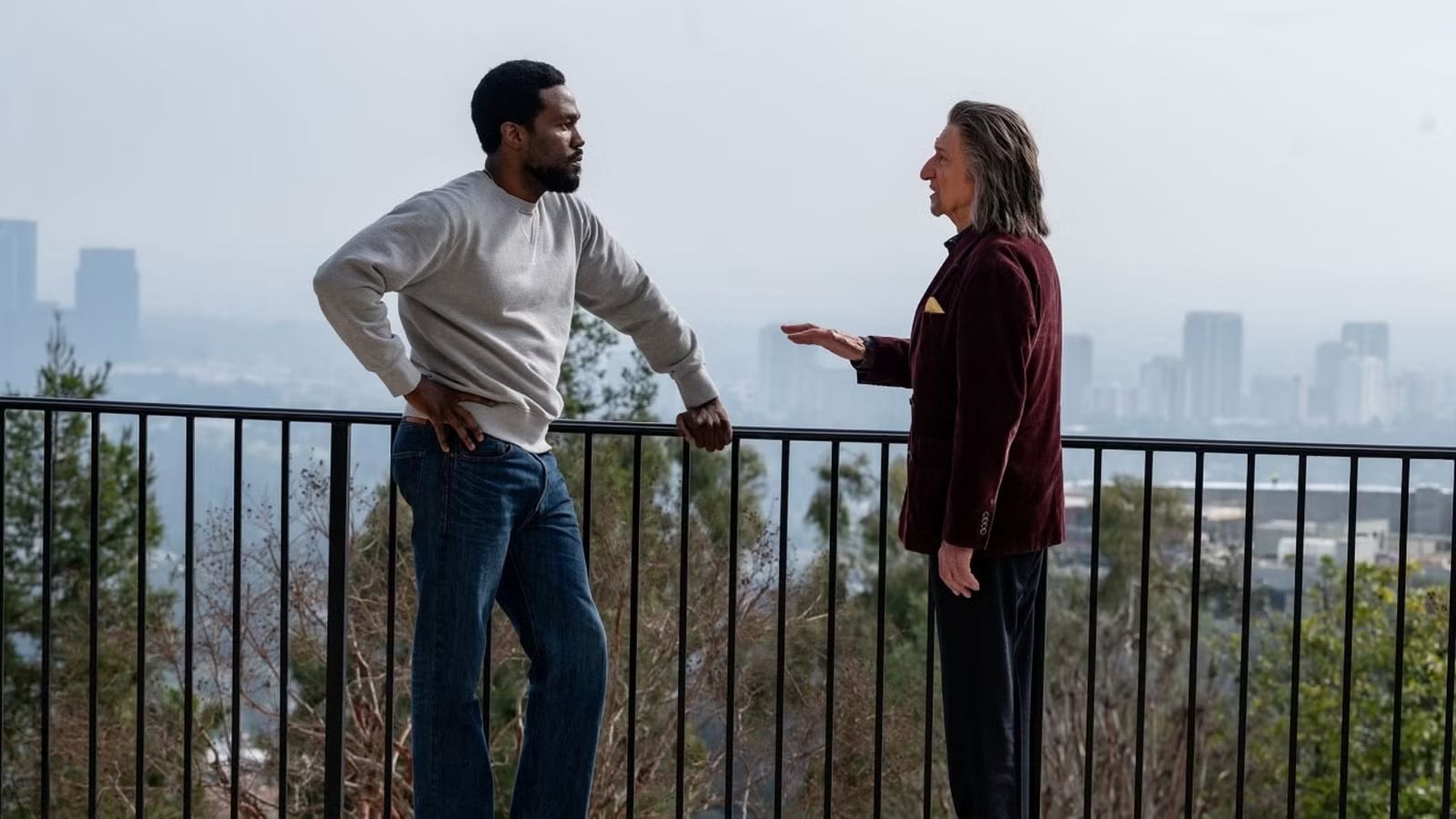
It may be over-reading things to say there’s a subtle Unbreakable reference in Marvel’s latest offering, Wonder Man (above), in flashbacks to the childhood of Simon Williams (a completely immersed, vulnerable Yahya Abdul-Mateen II) now a struggling actor in LA. He’s struggling not only with his career in TV and movies, but with the kind of perfectionism that gives rise to the reputation of being difficult, and most consequentially, the same kind of psycho-physical gifts that Clark Kent, Diana, Peter Parker et al experience as burdens. He’s a little less angry but just as destructive as the Incredible Hulk; one of the lovely strengths of the show is that while he’s desperate to hide his powers (because he can’t control them), the people who care about him the most already intuit his inner conflict, and are ready to create a safe place for him to land. If only he would be vulnerable enough to let them in.
And into this predicament arrives Trevor Slattery, one of the most satisfying comic creations in recent popular cinema, and an absolute hoot of a role for Ben Kingsley. First appearing in Iron Man 3 and later Shang Chi and the Legend of the Ten Rings, Trevor came to prominence playing a nefarious exotic terrorist called The Mandarin, a cover story for a techbro imperialist who realized the diversionary power of bigotry wrapped up in fear. The down-to-earth Londoner went to prison, but later escaped and turned out to be a decent guy after all. Trevor just loves acting - he sees it as a calling, and that the “success” of a career matters much less than the quality of the work. For Trevor, acting “is the single most consequential thing a person can do with their life”. When first uttered in Wonder Man, that phrase, a divine mission statement for Trevor is a joke for us; but what’s sincerely wonderful about Wonder Man is that it turns out to be true. Trevor’s most courageous act is indeed an act - not in the sense of a lie, but in taking on a role that serves only the good, even though it costs him mightily. Myths don’t have to be true to be authentic; fantasies are sometimes more spacious than facts; sometimes it really is the case that the most powerful thing in the world is not an invisibility cloak, a magic cape, laser eyes or wrists that shoot webs, but the ability to discern and tell a better story.
The show’s co-creator Destin Daniel Cretton has made movies characterized by a openhearted compassion (his Short Term 12 is an underseen gem); together with Andrew Guest he has infused the latest Marvel offering with humanity and generosity, and an affection for cinema that goes beyond in-jokes for the sake of it. Midnight Cowboy shows up in the first episode, but by the end that exquisite movie’s honoring of male friendship has become the heart of the series; there’s a reference to how the Criterion Collection and movies generally can comfort the lonely; and in the last episode a very subtle nod to The Straight Story, David Lynch’s film about an utterly heroic act by an utterly ordinary person (an elderly man who drove his ride on lawnmower for six weeks in order to care for his ailing brother), making the utterly mundane into the utterly miraculous. That’s one of the places, also, where Wonder Man invites an expansive notion of who belongs in America - a Black middle class actor, an immigrant working class Londoner, a Midwestern cog in the machine, a Latino “gang” who infuse their kaleidoscopic culture into candy that makes the heart sing.
At times Wonder Man made me think of both the fourth wall-breaking of Jean-Luc Godard and the humane chaos of the Muppets, and that’s a compliment; it’s less in love than many with the idea that violence resolves things; and it’s serious about one of the most important questions we face: How telling stories shapes reality. Wonder Man wants us to think about how storytellers must take responsibility for the exercise of their gift; you can collaborate with a dominating national myth or co-create a vision of identity in which everyone belongs. It knows that soul-deadening to confuse acting (or storytelling) with celebrity, but in Trevor’s vision acting is living, living is acting, and the willingness to take acting seriously is the willingness to free other people from their burdens.
Wonder Man is on Disney +.
Kathleen Norris: A SOMEBODY STANDS UP TO PUTIN
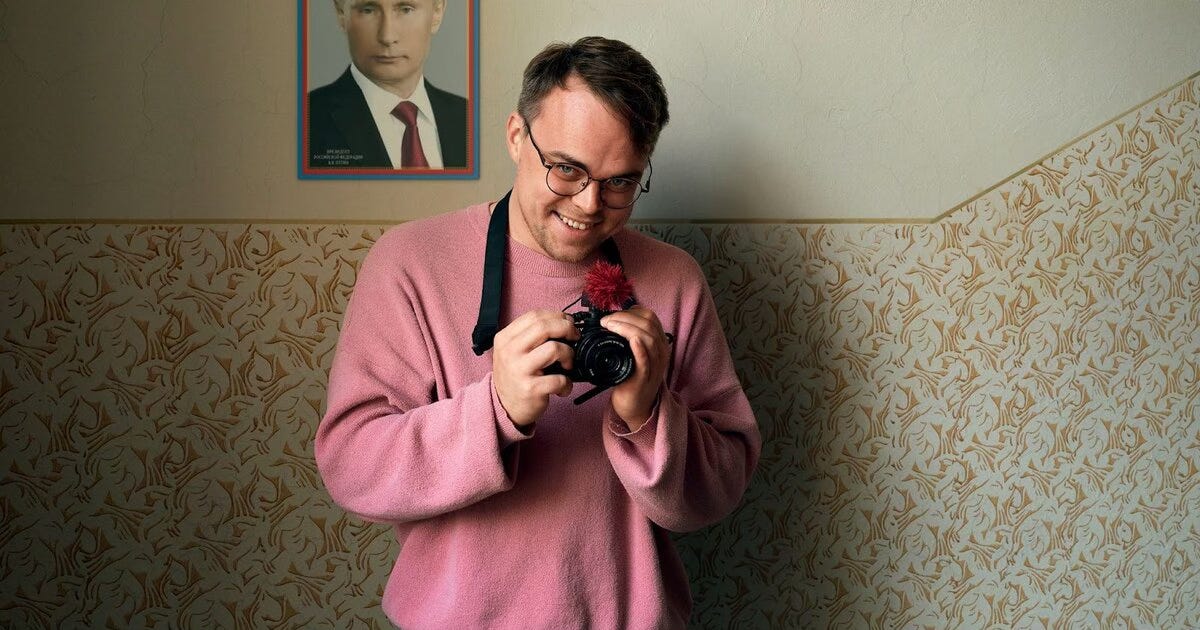
Mr. Nobody Against Putin is one of the saddest films I have ever seen, and also one that is vitally important to see now. Its impact continues to grow on me, as I reflect on the courage a young filmmaker, Pasha Talankin, shows in documenting the militarization of education in Russia following its invasion of Crimea in 2022. He was a teacher in a school in Karabash, a small industrial town in the Urals, once designated by UNESCO the most toxic place on earth. Due to the pollution there, life expectancy there is 38 years.
But it’s Talankin’s hometown, and he professes to love even its refinery towers and the grey apartment buildings from the Soviet era. Most of all, he loves his students. He worked as the school’s videographer, filming events at the school, and many of the school’s teenagers clearly enjoyed hanging out with him. But his job changed drastically in February of 2022, when the school, like every school in Russia, received a document entitled “New Federal Patriotic Education Policy.” It required schools to hold military-style flag ceremonies every day, and instead of teaching subject matter, teachers were instructed to read propaganda provided by Putin’s regime. The government also provided students with patriotic scripts to read to their classmates. Talankin was to film classes and upload the footage to what he calls “a mysterious government database,” to prove that the school was cooperating.
One painful scene depicts a teacher attempting to say words like “denazification” and “demilitarization,” referring to the government’s stated aims in invading Ukraine. Talankin gently offers her the correct pronunciation. We hear a history teacher tell students that Europe has become so corrupt it no longer produces any agricultural products and proudly declare that the Russian army will destroy the Ukrainian forces “in a matter of days.” He adds that it is crucial for the Russian government to “eliminate dissenting views.” When Talankin asks him what historical figures he would most like to meet, he names Beria, Stalin’s notoriously cruel chief of police and the inventor of the Russian gulag penal system.
Talankin decides to resign, but soon realizes that the school has become his family, and that he owes it to his students to offer a witness to the fact that indoctrination is replacing education. It’s stunning to see mercenaries in the Wagner Group offer a “show and tell” to impressionable young people, having them view grenades, machine guns and other weaponry. It is clear that the aim is to equate patriotism with the willingness to serve as cannon fodder in the Ukrainian war. The innocent faces of the children listening with rapt attention grieved me, but I laughed when Talankin, at the risk of arrest, inserted Lady Gaga’s rendition of America the Beautiful into one of the school’s daily flag ceremonies. I was relieved that even though school administrators were shocked, he got away with it. In 2023 a law was passed in Russia making any opposition to the Ukraine war a capital offense, but Talankin risks having a small blue and white flag on his office wall, representing Russia’s pro-democracy movement and resistance to the Ukraine war.
Talankin’s love for his students is palpable, as is his grief as young men graduate and enter the army. He knows that many won’t survive. But as Russian casualties in Ukraine mount, and the government wants to suppress that information, it becomes too dangerous for him to film the funeral of one of his former students. What he does instead is brilliant, and also heart-breaking. He creates a scene that amounts to a Turing test: if you can watch it without weeping, you may not be human.
Talankin’s experience reminded me of what I was told by a man who had been in elementary school in China during the “Cultural Revolution” that began in the late 1960’s. He said that the teachers stopped teaching mathematics and reading and instead read “patriotic” statements issued by the Maoist regime. That young man’s mother, a teacher, managed to get him out of China to join her in Hong Kong.
Tallankin spots a police car parked near his apartment and begins making plans to leave. But there is no such escape for the young people of Karabash, and this film leaves us feeling angry to see how badly they are being used and abused by their own government. Most seem unaware of the oppression they’re being subjected to, but we feel it all too keenly. When Talankin delivers what he knows will be his final speech at the school’s graduation, it has many present in tears, including the history teacher who admires Beria. He could easily have been depicted as a monster, but to his credit Talankin insists that we see him as a human being.
The day after that event Talankin left Russia under false pretenses, with a round-trip train ticket. But he knew that he couldn’t return. He was assisted in his escape by a group of documentarians in Denmark he had met online. They took him in and helped him to finish his film. It’s nominated this year for an Oscar as the best documentary, and I hope it wins. This film is painful to watch but it also feels necessary at a time when too many government officials are attempting to present ies as truth, and offering citizens definitions of patriotism that serve only those in power.
According to the Center for Strategic and International Studies, founded in Washington D.C. during the Cold War, last year 35,000 Russian soldiers died each month in the Ukraine war. I can’t read a statistic like that without seeing the innocent and hopeful faces of the young people in Talankin’s film. In making us a witness to a nation’s crimes against its own people, he has demonstrated the power of film to awaken and challenge the conscience of everyone who sees this documentary.
Mr. Nobody Against Putin (2025, directed and narrated by Pasha Talankin, co-edited by David Borenstein ), is streaming on Amazon, AppleTV, and Roku.