
WITNESSING
And anticipating THE ODYSSEY

Kathleen Norris on TWO PROSECUTORS
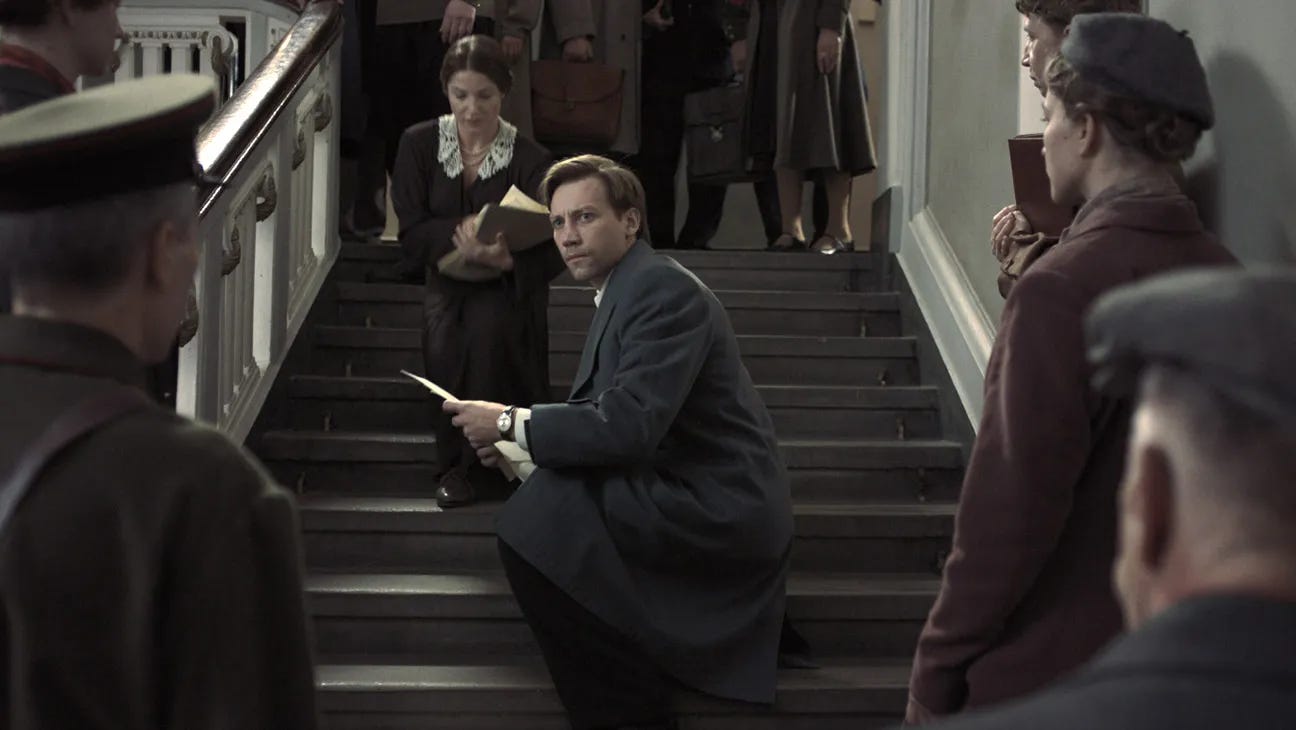
I’ll watch any film the brilliant Ukrainian director Sergei Loznitsa makes, although I know that he’ll make me suffer along with the film’s protagonists, as he presents people struggling to make moral decisions in grim circumstances. I also know that some of his images will haunt even my waking hours. I’ve written about his My Joy, a strikingly joyless film about the collapse of human decency in today’s Russia, as well as the masterful In The Fog, about the the cruel manipulation of the civilian population during the Nazi occupation of Belarus in World War II. They demoralized people so thoroughly that they feared to trust each other, which brings me to Loznitsa’s new film, Two Prosecutors (above), set in 1937 during the height of what is now called Stalin’s “reign of terror.”
Much of the film takes place in a prison in a rural town, Bryansk, that holds both ordinary criminals and political prisoners accused of “anti-social behavior,” which at the time could mean almost anything. Loznitsa takes us through narrow hallways and dark stairwells at such a slow pace that the prison’s sinister and oppressive atmosphere sinks into our bones. The many scenes of barred gates and thick iron doors opened and closed by coldly indifferent guards creates such a sense of being trapped that I’m tempted to offer a trigger warning to anyone who suffers from claustrophobia.
We meet a young prosecutor, Kornyev, (a well-cast Alexandr Kuznetsov) fresh out of law school, who appears at the prison demanding to see a particular inmate. He knows he’s within his rights, but the fact that he has the prisoner’s name and cell number astonishes and disturbs the prison authorities, as this is information they have tried to keep secret. (How Kornyev obtained the information is a story in itself.) The officials make several attempts to discourage Kornyev from continuing with his quest, but finally allow him to visit the elderly inmate (portrayed unforgettably by Alexandr Fillippenko) whose cell is in the “special block” for enemies of the state. He shows the young prosecutor signs of torture on his body and tells him that many loyal Communist Party members like himself are being arrested and tortured until they sign confessions to crimes they didn’t commit.
This is dangerous knowledge to possess, and when it’s clear that Kornyev intends to act on it and launch an investigation, we fear for him. To believe in the rule of law during Stalin’s era (or Putin’s for that matter) can be fatal. But we accompany the young man as he sits uncomfortably in the cold, crowded carriage of an overnight train to Moscow, badgered by the tall tales and reminiscences of drunks as he attempts to get some sleep. He has assumed that the General Prosecutor in charge of the Soviet prison system will help him, and is willing to wait hours for an audience. Anatoliy Beliy is brilliant as the film’s wily second prosecutor, listening to Kornyev intently with a poker face. Improbably, he offers a glimmer of hope to Kornyev, an official paper that will prove to the prison authorities in Bryansk that he has consulted with the highest authority and can proceed with his investigation. He even buys him a train ticket in a first-class carriage. Kornyev is too relieved to be suspicious, and the rest of the film consists of the unfolding of cruel levels of betrayal that the naive Kornyev doesn’t see until it is too late.
Two Prosecutors rings true with memoirs of the Stalin era that I have read. In Nadezhda Mandelstam’s powerful Hope Against Hope she says that the two worst things about that time were the erosion of the capacity for hope, and the loneliness that set in when people become afraid to talk honestly to others, because you never knew who might betray you to the authorities. She herself managed a great feat of hope. Papers were routinely confiscated by the secret police, so after her husband Osip was arrested, she memorized his poems. He died in the gulag, probably in 1938, and in 1973, twenty years after Stalin’s death, her dedication reached fruition, when a volume of her Osip Mandestam’s complete poems was published in England.
I was struck by one small detail in Two Prosecutors. When Kornyev first visits the prison we see a group of grim-faced women standing outside the prison gates. Their presence is not explained, but they are waiting in vain for news of their husbands, sons, and brothers imprisoned inside. This occurred daily during Stalin’s reign, women waiting in long lines outside of prisons, to deliver packages containing letters, food, clothing, and shoes for their loved ones, not knowing if they had been moved to another prison or were already dead. The women were tolerated because the items they brought were useful, confiscated and regarded as bounty and shared by prison guards.
One day in the 1930’s the poet Anna Akhmatova stood with a large group of women outside the infamous Lubyanka Prison in Leningrad (now, thank God, known as St. Petersburg again). Her husband and son had been taken there and she was trying to get news of them. Another woman recognized her, approached, and whispered, “Can you describe this?” Akhmatova answered, “I can.” That story strikes me as the purest example of what art is for. It is to witness, and I’m grateful that filmmakers like Loznitsa are willing to answer the call.
Two Prosecutors (2025, directed and written by Sergei Loznitsa. Based on a novel by Russian physicist Georgy Demidov, who was imprisoned in the Soviet gulag from 1938-1958). Streaming on Criterion, for rent on Amazon and Apple+.
Gareth Higgins on CHRISTOPHER NOLAN

I imagine I’ll write about The Odyssey next week - Christopher Nolan’s film will be everywhere, and I’m excited to see it, but with the same nervous anticipation as I usually have for Nolan. He’s clearly one of the great cinematic visual stylists, soundscape-designers (and yes I know sometimes we can’t hear all the dialogue, but I think that’s part of the point - it makes us look more deeply at what’s happening on screen, and makes the movie feel more like real life), and stewards of time (Dunkirk’s three-story structure is far more innovative than was typically acknowledged, and Inception knows something about how dreams can feel much longer than the sleep that contains them), and he makes films that are intelligent and enormous, witty and thrilling at the same time - genre blockbusters with something to say. But there’s a bleakness about Nolan’s work that I find curious, and what matters most to me about his version of The Odyssey (and the version we need to see right now) is whether it will thread the needle between the myth of redemptive violence (wherein killing “cleanses” the world) and the myth of redemptive suffering (wherein some people - usually marginalized ones - are “cleansed” through being tormented). I want to see an Odyssey that honors the reasons why sometimes people feel the need to defend themselves, without enshrining the idea that violence is good.
I’ll check back in once I’ve seen it - for now, here are my thoughts on Interstellar - probably my favorite of Nolan’s movies, partly because it has the most heart.
