
Natchez
And Why The Movies Don't Feel the Same Anymore

Gareth Higgins on NATCHEZ
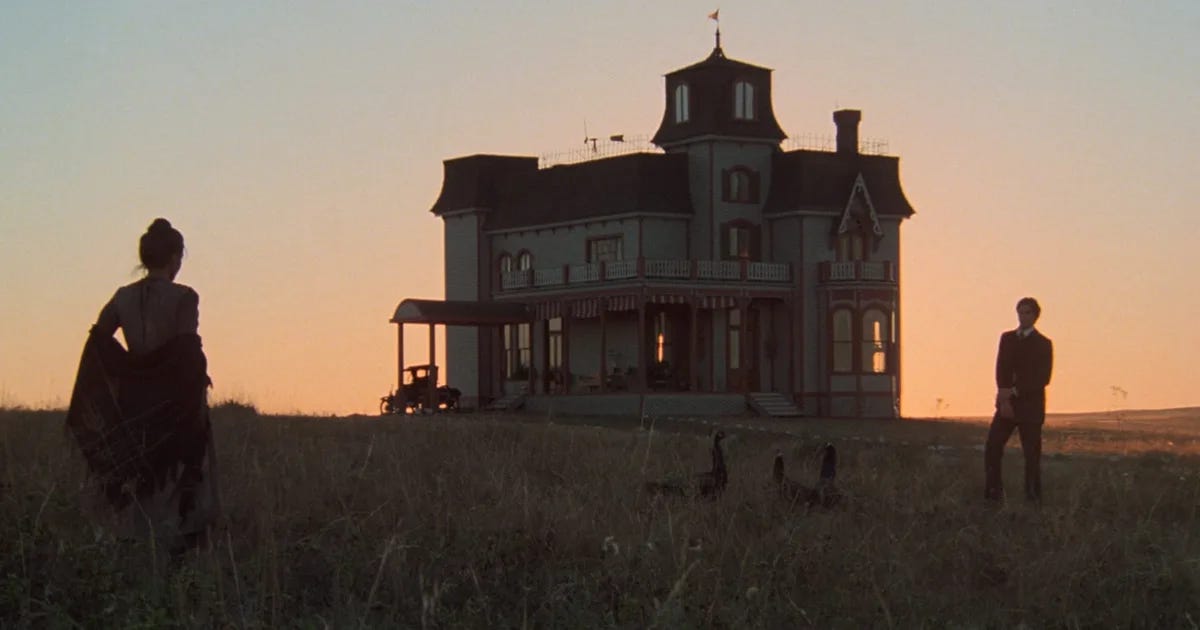
I saw two movies this past week that illustrate both the limitations and continued possibilities of cinema: Natchez (directed by Suzannah Herbert, which PBS is streaming under the title The Myth of Southern Charm), and the critic Thomas Flight’s video essay Why The Movies Don’t Feel The Same Anymore. (The image above is from Days of Heaven, perhaps the movie I most wish more movies felt like.)
Natchez is marketed as a documentary, but that term needs to be interrogated. John Grierson, the person who first applied it to cinema, meant by it “the creative treatment of actuality”; but the range implied by that definition includes everything from a History Channel film about D-Day to the three-hour Chicago basketball masterpiece Hoop Dreams, Michael Moore’s agitprop Fahrenheit 9/11 and Godfrey Reggio’s meditative film about faces and landscapes Visitors. “Documentary” doesn’t feel adequately descriptive for Natchez; I might prefer to call it a cinematic essay about people trying to make sense of the world, some more consciously than others. Unobtrusively observational, Herbert’s camera reveals rather than announces the stories of several people in that extraordinary town, orbiting its previously lucrative and now in need of evolution “pilgrimage tours.”
Some folks come to see how the Old South lived, which for many appears to mean not much more than how Scarlett O’Hara lived; there are women co-hosting the tours who wear hoop dresses without paying much attention to how their previous owners achieved social standing in the first place. Rev Tracy Collins, a Black minister and tour guide, doesn’t let his guests get away with the sanitized version of city history that limits itself to discussions of silverware and “service”. The stories of enslaved people are indivisible from the stories of these mansions. Shocking and tragic is the racist language and supremacist demeanor of David, an elderly white homeowner, who comes close to self-caricature. Yet more tragic is the fact that as a gay man in a homophobic society he has surely experienced marginalization, but being oppressed is no guarantee of solidarity with others more oppressed than you. It would have been easy for Herbert to just let David make a fool of himself; but we also see the effects of a diminishing neurological condition on his movement and voice. He is not a figure of mockery, but of humane confrontation.
Herbert also allows another Tracy, a woman in midlife who says she never felt truly beautiful until she put on the hoop dress. Condescension becomes something more like hope when we see her begin to reflect on the whitewashing of her city’s history as one of the largest slave markets; we’re helped by witnessing the pathos, post-divorce, of her saying that she’d rather have peace than wealth.
The refusal to demonize anyone is mirrored by Herbert’s willingness to portray two of her “characters” as brave in ways that count more often than under the spectacular circumstances which cinema more typically considers heroic. Rev Collins is narratively paired with Deborah Cosey a Black woman who operates an inn from a house in which enslaved people lived, naming some of the ancestors who inhabited the place she now stewards. Cosey catching a tear in her voice before saying “They made these bricks, you know” is the cinematic moment of the year so far. It also should have been the last moment of the film, which in its current form ends with a memorial attended by a multicultural audience, making things feel a little too neatly wrapped.
But that’s a small complaint — everything in this film belongs in it, and some of it represents a reality that has rarely been portrayed with such clarity. The mayor of Natchez seems to be more enlightened about the common good value of telling the whole story, that facing history is good for everyone. So what if that means facing your own complicity in the terrible deeds of your forebears? If what you hold has derived from the kidnapping, torture, and murder of even one person, wouldn’t you want to consider how to participate in repair of that curse?
Of course the you in that question will mean different things to different people. Some folks reading this are heirs to the harm done, and have spent their lives trying to heal, offering grace to those who have not yet acknowledged the harm. Some are working toward the transformation of the story that says some lives are worth more than others, that individualism matters more than community, and the myth of the self-made person. And some of us are both survivors of inherited trauma and hold resources we did not earn.
I’d like a northern Ireland film like Natchez, where the kaleidoscope of identity and experience would be named humanely, without overstating the responsibility of today’s leaders for yesterday’s horrors, nor understating the impact of those horrors, nor the proportion of responsibility. Herbert’s film is my favorite of the year thus far, and an example of what Thomas Flight is reaching for when he talks about how the movies have changed, but also what is still possible.
Watch Flight’s video essay here:
So much cinematic craft is deployed merely for storytelling (or spectacle) that doesn’t require much attention; the Kuleshov effect — the way cutting between two or more images creates meaning — is a power worthy of the most spiritually mature filmmakers.
Andrei Tarkovsky said that “the aim of art is to prepare a person for death,” but not in a morbid or nihilistic way. He was reaching for a way of saying that the only way to truly experience life is to accept the inevitability of death — death as a holy thing, a way of not taking ourselves for granted, of overthrowing monstrous power-over narratives in favor of prioritizing the miraculous simplicity of sharing among people, place, and planet.
We live in an era when movies are becoming more like television and television more like movies, and in which, as Flight implies, Barbie and Oppenheimer may light up the box office not because of their content or meaning, but because of their marketing. We may not expect another Jaws or The Exorcist - never mind a Schindler’s List - to project genuine cultural impact from inside a theater. We may mourn the grain of celluloid projection, the scarcity that made a night at the movies something special, and particularly the sense that watching with a captive audience of fellow humans conveyed a communal moment. But there are two things we can do to respond. The first is to support spaces where the wonder of film is being treated as just that - theaters committed to showing off the great works of cinema past and present in the best possible form, on the biggest possible screen. And the second is to recognize that cinema has “died” before - when sound came in, when color came in, when the Production Code came in (and went out), when Hitchcock died, when VHS arrived, when DVD arrived, when streaming arrived. Opera was once a populist activity; then it became an elitist one; now you can see The Metropolitan Opera at your local cinema for less than the price of three hours in a Manhattan parking lot. Things change. Not always entirely for the better, but the fact that there’s a PBS “documentary” available to watch for free on YouTube, and which demolishes the lies told in the highest-grossing film ever made; the fact that there’s a guy out there - a true amateur - one who loves what he’s doing who will devote himself to keeping the flame alive? Maybe cinema is just pretending to die, this time, again.
Watch Natchez here:
Kathleen Norris on THE PITT
My husband once said to a doctor, “I never get colds. I only get life-threatening conditions.” This wasn’t a joke. Over the years caregiving for him made me something of a connoisseur of emergency rooms, knowledge that has come in handy with other family members and also on the rare occasions when I’ve sought treatment myself. I learned a lot about how ERs work, why everything takes much longer than you think it should, and why it’s so important to establish a good rapport with hard-working and often harried nurses. They need all the help they can get.
My husband became a big fan of ER when the television series began in 1994, but I didn’t care to watch it. In all of our emergency room visits my husband was receiving medication to help him cope with his troubles, but I was taking everything in while I was stone sober. I didn’t want to revisit the noise, chaos, and drama of the typical emergency room, even in fictional form. My ignorance of the show did occasion one amusing moment. I was browsing in my favorite bookstore and overhead two women clerks talking about a handsome man named George, who sounded like a great guy. They went on and on, singing his praises, until I finally asked, “Who is this George you’re talking about?” They replied, “George Clooney. ” I replied, “Who the hell is George Clooney?” They were shocked, and I realized that all the time I was spending in Benedictine monasteries had put a big dent in my knowledge of contemporary culture.
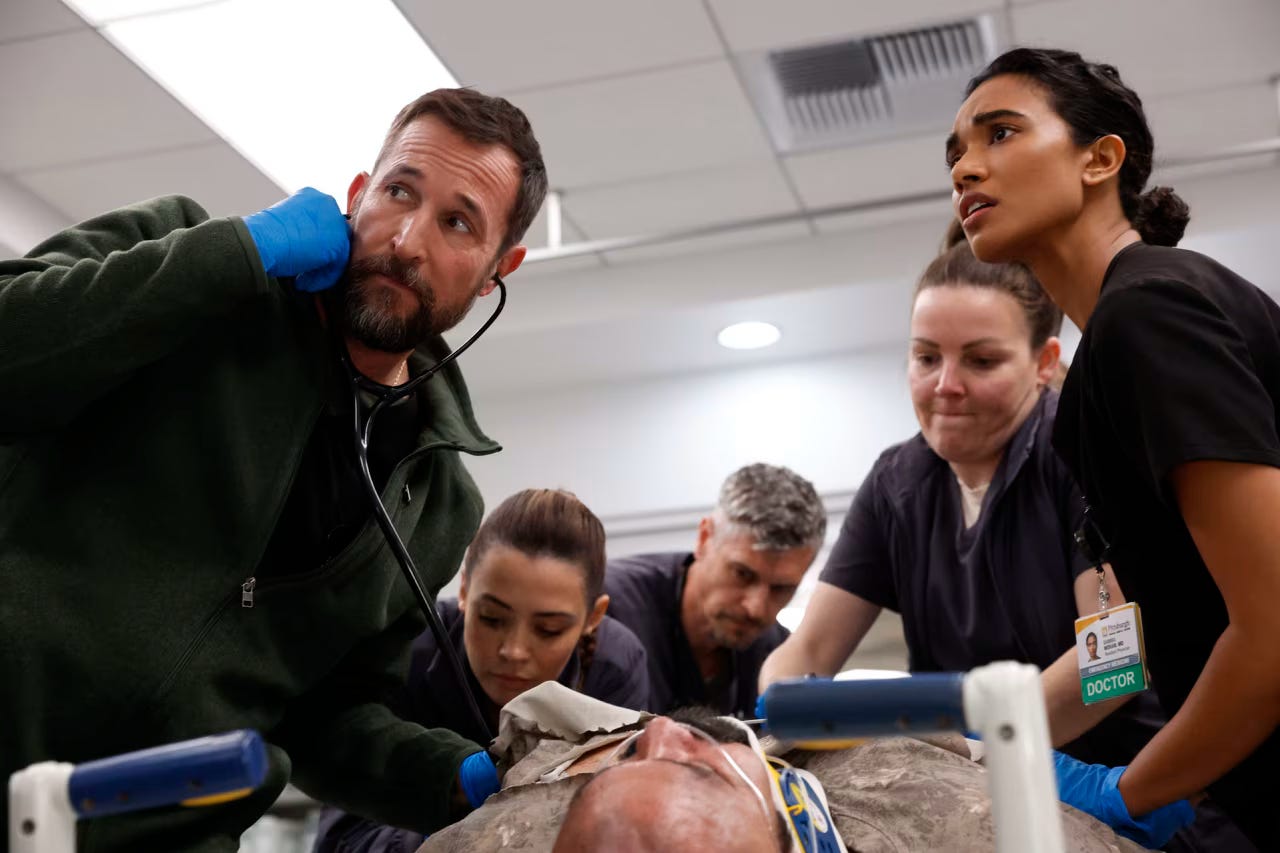
My husband died many years ago, but when The Pitt series began and received much critical acclaim I resisted tuning in. When I finally started watching the first season, I quickly became addicted. Medical professionals have praised the program for its accuracy, and I have found that it reflects my own experience of emergency room physicians and nurses. These are people who are experts at making a fast and accurate diagnosis of the conditions presented to them by often fearful patients. But at their best they also realize they’re treating human beings. The Pitt recognizes that, and does an excellent job of demonstrating that even small gestures of kindness can humanize the intimidating atmosphere of an emergency room. The show is fast-paced but slows down to an almost unbearable pace when the charge nurse is with a young rape victim, demonstrating both calm efficiency and compassion as she puts together a rape kit for the police. It’s an intense scene that makes the audience better understand the trauma of rape.
The Pitt is notable for holding up a mirror to American society and its dysfunctional health care system. We see a crowded entry room where people will wait many hours to be seen by a physician. We meet hard-working people with no medical insurance who can’t afford the medications they need stay alive, but make too much money to qualify for Medicaid. We meet parents who have refused to vaccinate their child against measles and then won’t accept responsibility for the brain damage caused by the disease. We meet a man whose rural hospital had closed, so his son had to drive him a long distance for the care that saved his life. We see obese people who are used to being judged and rejected, respond with tears when they realize the medical staff truly cares for them and will do all they can to help. We see young medical students who are tempted to judge patients being reprimanded by more experienced doctors and nurses.
In the first season I was especially moved by one scene in which a doctor grows frustrated at being unable to communicate with an obviously bright young patient, but another doctor recognizes that the man is autistic. She’s on the spectrum herself, and when she enters his room, she turns off the fluorescent lights, and engages him in a quiet conversation. It’s a moment of true healing, the medicine of another person knowing what someone needs, and being willing to be present and listen.
The second season shows the staff coping with a daunting variety of medical issues, including one unforgettable, harrowing scene of a woman giving birth while suffering from pre-eclampsia, which has put her life and that of her fetus at risk. But in this season we learn more about the personal struggles of the staff, especially the burnout that comes from laboring with intensity over long hours. The scene in which one intern flatly refuses to continue to work once her twelve-hour shift is done has created an online discussion among real world physicians who say that the current system that pushes nurses and doctors to work overtime is a danger to them and their patients. On The Pitt we see that some staff members have sought counseling and healthy outlets to cope with burnout. But the director of the ER, Dr. Robby (a wonderful Noah Wyle), while he knows his job is killing him, resists asking for help, and has everyone — his staff and the fans of the show - worried about him. In the season’s final scene, he has a moment of calm that we hope will lead to healing.
One of my neighbors is a emergency room nurse who has worked night shifts for years. She’s told she loves her job, because when she goes to work she has no idea what to expect. I’m grateful for people like her who are willing to step up and be present for people in a crisis. And I hope The Pitt will serve to gain more respect for the medical crews who work long hours, and are always there for us, ready to provide emergency care when we need it.
The Pitt is on HBO.